GEAR + HOME / DISPATCH
Slow Feeders and Food Puzzles
How to choose an appropriate feeding challenge and observe whether it helps rather than frustrates.
Start with the reason
A slow feeder or puzzle can change the pace and shape of a meal, but it is not automatically a solution. Begin with the reason you are considering one. Maybe the pet gulps, needs a small movement break, enjoys scent work or has been advised to find a quieter way to eat. If the product is meant to address a health concern, ask a veterinarian first. A puzzle that makes a pet work while nauseous, painful or excessively hungry is the wrong tool. The objective is a satisfying meal with an appropriate level of challenge.
Choose the easiest workable version
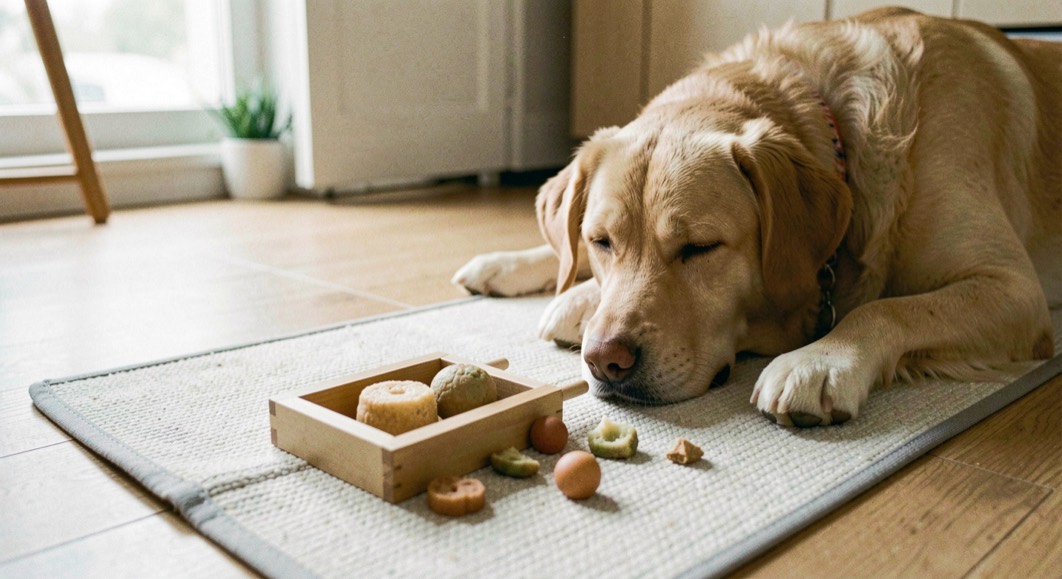
Place a small amount of the usual food in a broad, stable design and watch what happens. The pet should be able to understand the task quickly, move the food without panic and stop when the portion is finished. Grooves, compartments and rolling objects vary widely in difficulty. Start with an open surface before adding narrow spaces. For cats, a few scattered pieces in safe locations may be enough. For dogs, a lickable surface or simple scatter can be more useful than a puzzle that requires force.
Watch body language and clean-up
Interest looks different from frustration. A pet that sniffs, experiments, pauses and returns is using the puzzle. A pet that paws hard, vocalises, guards the object, abandons the meal or swallows pieces may need an easier design or a different feeding method. Inspect for cracks and damaged edges after use. Wash the item according to its material and let it dry fully. If another animal might steal the food, separate the feeding area. Safety and hygiene are part of the enrichment, not details to solve later.
Keep the diet stable during the trial
Use the food and portion already agreed for the pet rather than changing the diet at the same time. Measure the amount, offer the puzzle in a familiar place and note how long the meal takes, whether the pet finishes and how the rest of the day looks. A short trial creates information. If stools, appetite, weight or behaviour change, pause and speak with a professional.
Match challenge to the household
A clever puzzle that needs supervision may not fit a busy morning. Choose something the family can wash and refill without skipping meals. Some pets enjoy rotation, while others prefer a reliable object. Keep a bowl available when a veterinary diet, medication or appetite concern makes puzzle feeding unsuitable. For multi-pet homes, separate setups can prevent competition. Enrichment should add choice to care, not create a new source of pressure that people and animals learn to avoid.
Let the pet vote with repetition
The most useful review happens after several ordinary days. Does the pet approach the item, settle into eating and rest normally afterward? Is the object still intact and easy to clean? Does the household remember to portion it correctly? Keep what works and retire what becomes a chore or a source of stress. A simple cardboard scatter or a mat that can be licked may be the best answer. Food puzzles are one tool in a larger environment of movement, rest, scent and social choice.
KEEP THIS CLOSE
Four small moves
- Choose a puzzle for a clear purpose and an appropriate meal plan.
- Begin with an easy, stable design and watch how the pet solves it.
- Keep portions and food consistent while you evaluate the tool.
- Prioritise hygiene, supervision and a calm alternative when needed.
Sources & further reading
These links shaped the frame for this dispatch. They are starting points for a deeper conversation, not a substitute for individual advice.