HEALTH / DISPATCH
Adopting an Adult Rottweiler in North Carolina
What a household in North Carolina meets when it adopts an adult Rottweiler: breed standards, measurable health, the adoption file, training, law and insurance.
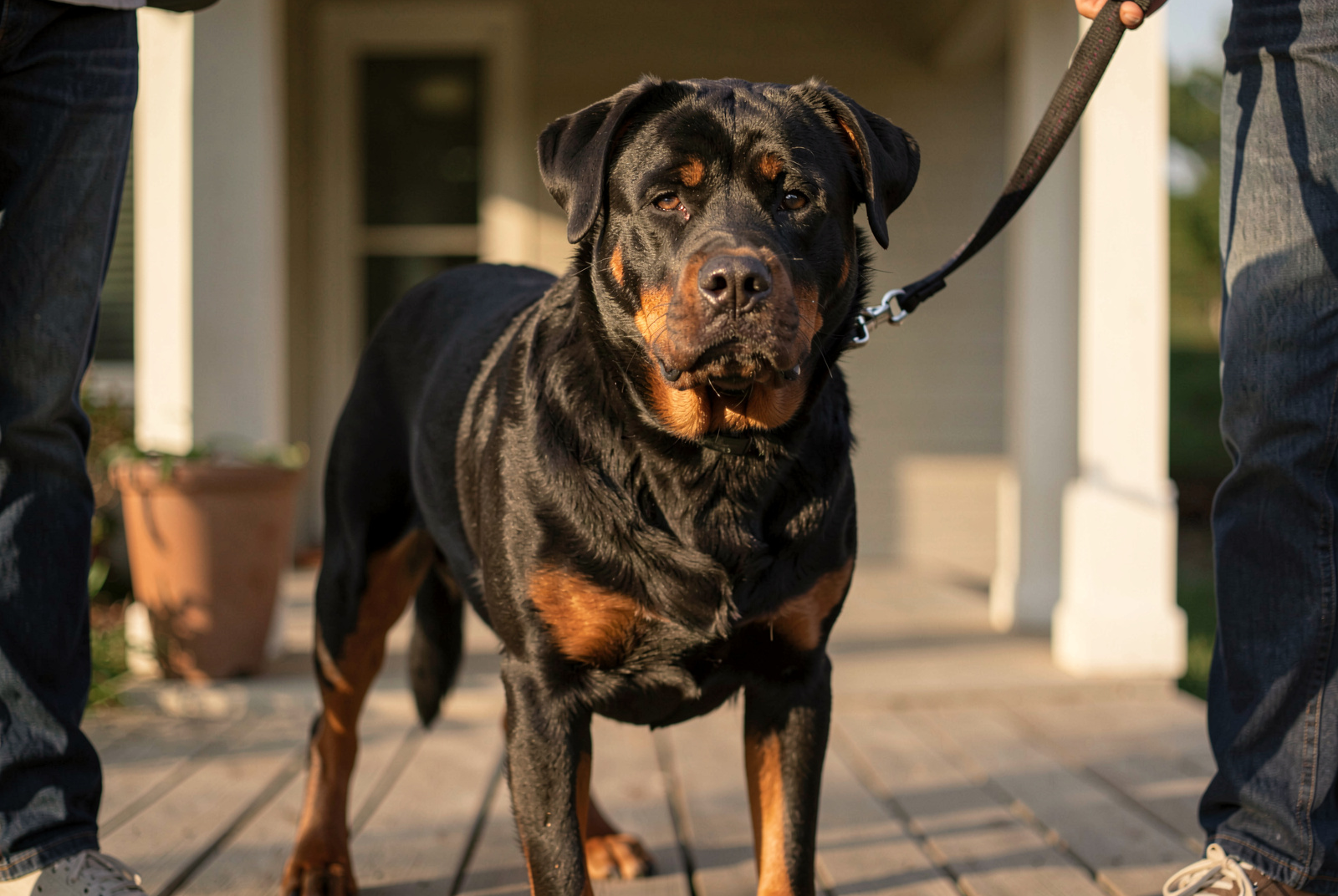
An adult Rottweiler adopted in North Carolina arrives already grown, already sized, and already shaped by whatever came before. The household does not raise the dog it chose; it receives the dog that exists. That single fact drives every practical question that follows, from the breed standard to the insurance contract.
What the breed standards actually say
Two official standards describe the Rottweiler, and they do not fully agree. A reader who wants to know what the dog in front of them is supposed to be should start there, because the written standard and the folklore repeated about the breed are two different documents. One is a description used by breeders and judges. The other is a set of stories passed between strangers.
What matters for an adult adoption is narrower. A grown dog cannot be measured against a puppy's projected lines. It can be measured against what is visible now: height at the shoulder, weight carried, proportion of body to leg, condition of the coat, and the way it moves. Those are the parts of a standard that survive into adulthood and can still be checked by hand and eye.
A household that reads the standard before meeting a dog arrives with better questions. It stops asking whether the dog looks like the breed and starts asking whether this particular body is sound, comfortable, and able to do what daily life will ask of it. The survey at ncrottierescue.net follows that same order, from the written standard to the insurance contract, in the sequence a household actually meets them.
Rottweiler health: what can be measured?
Health in this breed sorts into three families, and the sorting is useful because each family calls for a different response.
The first family is what an exam can measure. A veterinarian can assess joints, heart sounds, eyes, teeth, weight, and gait. These findings are concrete and can be requested before an adoption is finalized, usually as part of the medical record the placing organization already holds.
The second family is what medicine can treat. Infections, parasites, dental disease, skin conditions, and many chronic problems fall here. They are manageable, often routine, and rarely a reason to walk away from an otherwise suitable dog.
The third family is what an owner can only watch. Some conditions in large breeds appear later, and no test at adoption day predicts them with certainty. The honest answer is that a household accepts a degree of uncertainty and plans for regular veterinary care rather than a single clearance.
For an adult dog, this three-part split is more useful than a checklist. The exam findings are known now. The treatable items are budgeted. The watchful items become part of an annual routine.
Adopting a Rottweiler: what does the process ask of you?
The machinery of an adult adoption runs end to end, and it is worth knowing the sequence before starting.
A dossier asks for the basics: household composition, housing situation, other animals, work schedule, and veterinary references. The questions are not a test of worth. They exist because a large adult dog placed in the wrong household is returned, and a return is hard on the dog.
A reference call checks what the dossier claims. Previous veterinarians are often contacted to confirm that earlier animals received care.
A home visit looks at the physical setting. Fencing, gates, stairs, floor surfaces, and the space a dog would actually use. It is a practical inspection, not a judgment of decor.
The first month does something to both the dog and the household. A grown Rottweiler that has lived elsewhere is reading a new building, new sounds, and new people while the household is reading the dog. Expect a period of quiet observation rather than instant affection. Structure, predictable meals, and the same walking route at the same time do more in those weeks than long training sessions.
Training a Rottweiler that has a past
This is the part of adult adoption with no historical address. There is no puppyhood to reference, no breeder to call about early socialization. The training starts from the dog that arrives already formed.
Three things carry the work.
The first is body language. A large dog communicates stress, interest, and discomfort through posture long before it acts. Learning to read a stiffened stance, a held breath, or a turned head gives the handler time to change the situation instead of reacting to it.
The second is size. A Rottweiler is a powerful animal, and a leash correction that would be trivial for a small dog is not trivial here. Force-based methods carry more risk with a dog this strong, and they also tend to produce the opposite of the intended result in a dog with an unknown history.
The third is routine. Predictability is the training tool that works fastest on a dog whose past is unclear. Feeding at fixed times, walking a familiar loop, and ending each day the same way builds a baseline from which any specific skill can be taught.
A reliable recall, calm leash manners, and settling on cue are reasonable goals for the first months. They are built with repetition and reward, not with pressure.
North Carolina dog law and insurance
A state can impose no breed restriction while an insurer refuses the household. In North Carolina, the two regimes operate side by side, and a reader meets them together.
At the state level, North Carolina law does not single out breeds in the way some local ordinances have attempted. Local rules can still exist, and a household should check with the municipality where it lives rather than assume.
At the insurance level, the situation is different. Homeowner and renter policies are written by private companies, and those companies set their own rules about dogs. Some ask about breed, some ask about bite history, and some ask about neither. A policy may exclude liability for a dog, raise the premium, or decline to renew.
For a household adopting an adult Rottweiler, the practical step is a phone call before the adoption is finalized. Ask the insurer directly whether the breed is covered, whether a bite history matters, and what documentation is required. The answer determines whether the dog can live in the home under the policy that already exists, or whether a different policy is needed.
This is the point where the written standard, the veterinary record, and the adoption file all meet a single question: can this household keep this dog, legally and financially, for the next several years? Answering it early prevents the hardest outcome, which is a second rehoming for a dog that has already had one.
What a household should prepare before the dog arrives
Preparation for an adult Rottweiler is mostly physical and administrative.
Physically, the home needs a crate or a defined resting area sized for a large dog, flooring that can be cleaned, secure doors and gates, and a vehicle arrangement that can carry the animal safely.
Administratively, the household needs the veterinary record from the placing organization, a scheduled first appointment with a local veterinarian, a copy of the insurance policy with the dog added or confirmed, and a written routine for the first two weeks.
Emotionally, the household needs patience with a dog that may not seek contact for days. An adult Rottweiler that has been moved is not being aloof. It is assessing. The assessment ends when the routine proves reliable, and it usually ends faster than the household expects.